Cloud types / Stratus
Stratus · St
| Cloud level | Low |
| Altitude | Base below roughly 2 km |
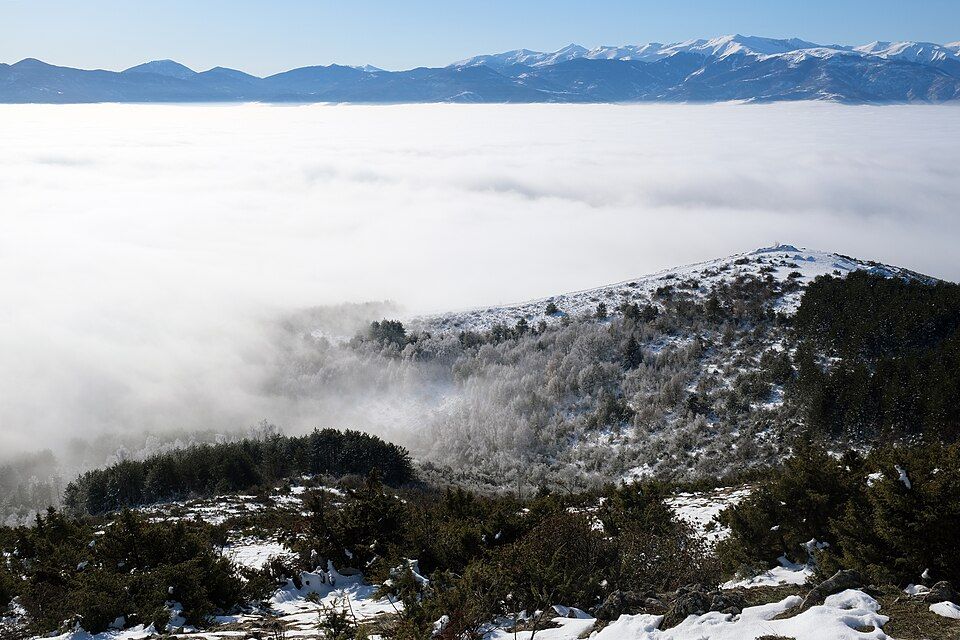
Stratus appears as a generally grey, featureless cloud sheet with a uniform and fairly low base that often encloses elevated terrain or skyscrapers. When the sun shines through, its outline is distinctly visible without optical halo phenomena. As one of the lowest cloud genera, stratus significantly reduces surface visibility and ceiling heights, making it critical for aviators, maritime navigation, and daily ground observations.
How it forms
Stratus develops when widespread cooling chills moist air near the surface to its condensation threshold. This frequently occurs through nocturnal radiative cooling, the advection of warm air across cooler terrain or water bodies, or the lifting of an existing fog layer as gentle surface winds stir the boundary layer.
Identification keys
- Uniform, diffuse horizontal grey layer lacking individual elements
- Base rests below roughly 2 km, sometimes touching ground as fog
- Sun's disc remains cleanly discernible through thinner patches
- Absence of optical halo phenomena around the sun or moon
- Ragged, detached shreds may form underneath the main deck
Typical weather
Stratus typically brings dull, overcast conditions with limited surface visibility. Unlike nimbostratus, it normally produces no precipitation reaching the ground, though light mist or trace dampness can occasionally occur beneath extremely low or ragged cloud fragments.
Often confused with
Photography tip
Include elevated landmarks, treelines, or buildings in your frame to establish scale and emphasize the low, uniform ceiling of the cloud base.
Questions about this cloud
What is the physical difference between stratus and fog?
Stratus and fog are essentially the same cloud structure, distinguished solely by altitude. A fog layer that lifts off the surface becomes stratus, while stratus touching the ground is classified as fog.
Can stratus clouds produce halos around the sun?
No, stratus is composed of liquid water droplets rather than ice crystals, so it cannot produce optical halos. The sun or moon appears with a sharply defined edge through thin stratus rather than a luminous ring.
Got a photo like this? Run it through the identifier: