Cloud types / Stratocumulus
Stratocumulus · Sc
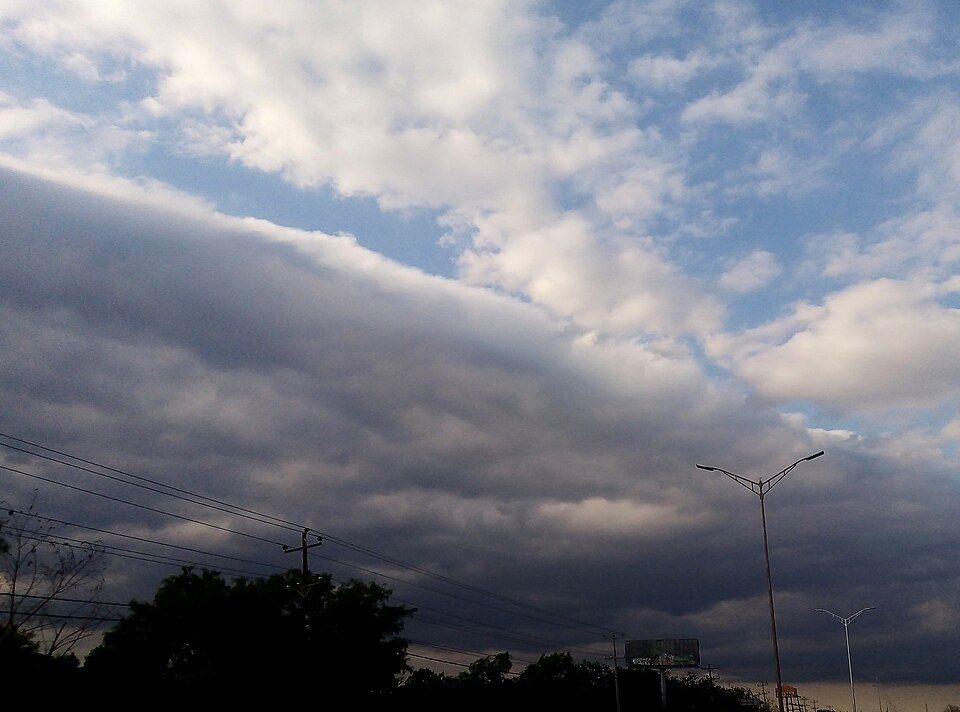
| Cloud level | Low |
| Altitude | Base below roughly 2 km |
Stratocumulus is a low-level layer or sheet of grey or whitish clouds, typically composed of rounded masses, rolls, or tessellated patches with dark parts. It is one of the most widespread cloud genera over both land and oceans. Identifying stratocumulus helps observers understand lower-tropospheric stability and moisture distribution, as these clouds often mark a capping temperature inversion that prevents stronger vertical convection from developing.
How it forms
Stratocumulus forms when weak upward convective currents spread laterally beneath a temperature inversion, or when turbulent mixing occurs in a moist boundary layer. It can also develop through the decay and flattening of cumulus clouds in the late afternoon or the gradual lifting of a continuous stratus sheet.
Identification keys
- Low-level layer or patches of regular clumps, rolls, or mosaic-like segments
- Most individual elements appear wider than 5 degrees across at arm's length
- Distinct light and shaded portions across the rounded underside
- Typically forms below a capping temperature inversion
- Non-fibrous appearance without silky or striated ice crystal textures
Typical weather
Stratocumulus typically brings dry conditions or occasional light drizzle, but no continuous or heavy rain reaches the ground. It often signals stable lower-tropospheric air, persisting during calm weather or marking the transition between clearing skies and low overcast.
Often confused with
Photography tip
Frame the shot with a wide focal length toward the horizon to emphasize the regular perspective and undulating rolls of the cloud deck.
Questions about this cloud
Can stratocumulus produce heavy rainfall?
No, stratocumulus does not produce heavy rain. It normally yields no precipitation reaching the ground, or at most intermittent light drizzle.
How can you tell stratocumulus from altocumulus?
Hold your hand at arm's length; individual stratocumulus elements appear larger than the width of three fingers (roughly 5 degrees), while altocumulus elements are smaller.
Got a photo like this? Run it through the identifier: