Cloud types / Cirrostratus
Cirrostratus · Cs
| Cloud level | High |
| Altitude | Base roughly 5-13 km |
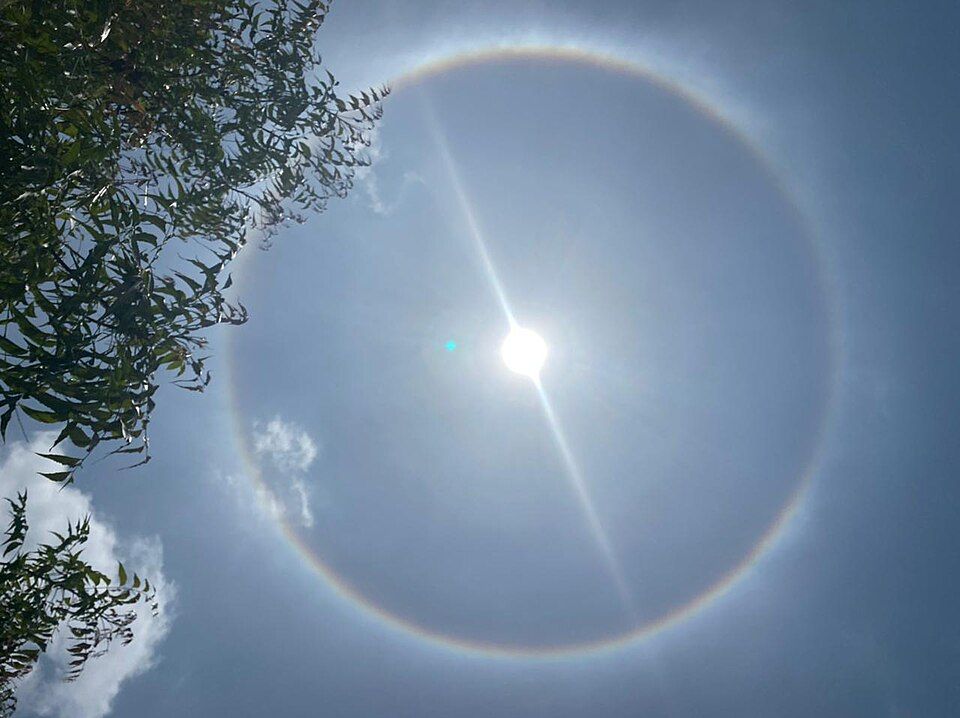
Cirrostratus is a transparent, whitish cloud veil of fibrous or smooth appearance, totally or partially covering the sky. Because it consists of millions of hexagonal ice crystals high in the atmosphere, it frequently produces luminous optical halo phenomena around the sun or moon. Although sunlight penetrates the thin veil easily, creating sharp ground shadows, a thickening sheet of cirrostratus is one of the most reliable visual signals of an advancing warm front.
How it forms
Cirrostratus forms when a broad, gentle upward slope of moist air is forced over a cooler air mass along a warm front. As air glides upward into freezing temperatures, water vapor sublimates into a widespread, uniform veil of hexagonal ice crystals.
Identification keys
- Thin, whitish veil with a fibrous or milky appearance
- Frequently generates distinct 22-degree solar or lunar halos
- Sun and moon remain clearly visible with sharp shadows
- Composed entirely of high-altitude ice crystals
- Covers extensive areas or the entire celestial dome
Typical weather
Cirrostratus produces no surface precipitation. A persistent veil thickening into lower mid-level clouds reliably signals the approach of a warm front or low-pressure trough, typically bringing steady rain or snow within twelve to twenty-four hours.
Often confused with
Photography tip
Block the sun disc with a tree branch or building edge to avoid blown highlights and expose halo arcs cleanly.
Questions about this cloud
Why does cirrostratus create rings around the sun or moon?
Refraction of light through hexagonal ice crystals at a minimum 22-degree angle creates circular halos.
Does a halo around the sun always predict rain?
It signals high-altitude moisture ahead of a warm front, which frequently, but not guaranteed, leads to precipitation within a day.
Got a photo like this? Run it through the identifier: